📍 East China is where China’s economy first opened to the world. With its ports, cities, and early policy head start, it’s long been a manufacturing and finance powerhouse. There’s something subtler happening now—across Zhejiang, Shanghai, Anhui, and Shandong, new luxury ingredients are quietly being grown, bred, and harvested.
🐟 Zhejiang: Caviar from Thousand Island Lake (千岛湖)
At the heart of Zhejiang lies Thousand Island Lake—a sprawling, emerald-green reservoir with over 1,000 small islands. Tourists know it for its serenity. But food insiders know it for something else: caviar.
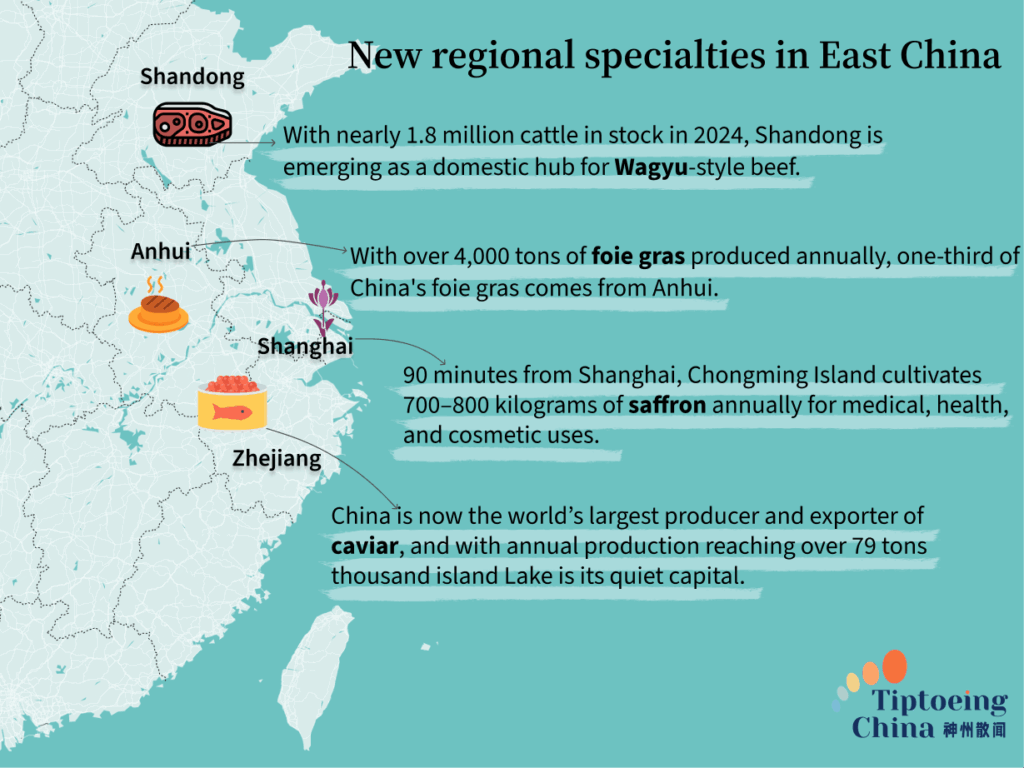
China is now the world’s largest producer and exporter of caviar, and with annual production reaching over 79 tons, Thousand Island Lake is its quiet capital. The lake’s warm, clean waters allow sturgeon to mature faster than in northern regions, shaving years off the typical 8–10 year cycle needed before roe can be harvested.
The species used? Native sturgeon from Heilongjiang, bred for high roe yields and adapted to different water temperatures. At the center of it all is Kaluga Queen, based near thousand island lake, which supplies 40% of the global market—from Michelin kitchens to Lufthansa First Class.
🧠 Behind the luxury
- Each sturgeon is tagged and tracked—AI drones count populations from above
- Every net pen now has a waste collection system (“floating toilets”), part of China’s stricter aquaculture standards
- Fish waste is repurposed as fertilizer—for nearby crops like pomelo
- To expand its cold-water capacity, Kaluga also operates breeding bases in Ya’an, Sichuan, where glacial meltwater and year-round cool temperatures create ideal conditions for early-stage sturgeon farming
📦 The trust gap
Kaluga’s quality is no longer in question—but its label still is. Most Chinese caviar is exported under foreign brands, reflecting ongoing concerns about “Made in China” food safety. Kaluga Queen’s blind taste-test win with Lufthansa is one step toward changing that.
🌸 Shanghai: Saffron from the Island Most Have Never Heard Of
When people think of Shanghai, they picture skyscrapers and stock tickers—not farmland. But just 90 minutes from the Bund sits Chongming Island, China’s third-largest island, nestled in the Yangtze River Delta.
Once known mainly for rice and tourism, Chongming has been cultivating saffron for decades—a flower originally from Iran valued both in Persian cuisine and Chinese herbal tradition, where it’s good for blood circulation.
- The island now grows saffron across more than 0.7 square kilometers
- The annual output reaches 700–800 kilograms and a total value of over 30 million RMB (about $4.1 million USD).
🌱 What’s different here?
- Due to climate differences with Iran, Chongming farmers use a split method:
- Spring–summer: bulbs grow in open fields
- Fall–winter: flowers are forced in greenhouses, then replanted
- This technique allows for controlled blooming and higher yields
- The crop has brought new income and inspired derivative products: saffron-infused rice, liquor, and even face masks
🥩 Shandong: Breeding Local Luxury
Known for its strong agricultural base, Shandong is now emerging as a domestic hub for Wagyu-style beef. With nearly 1.8 million cattle in stock (2024), the province provides both the scale and infrastructure for premium beef production.
- Local farms are raising a hybrid breed: Japanese Wagyu crossed with Shandong’s native Luxi Yellow Cattle
- The result: a marbled, high-fat beef tailored for Chinese tastes—and priced below imported Wagyu
- For now, most of this “Chinese Wagyu” is sold domestically, as the market gradually develops
- Export remains limited, but demand is growing, especially among younger, health-conscious consumers seeking better quality and traceability
While it may not yet be a global name, Shandong’s cattle industry is laying the groundwork for a new kind of local luxury—where East Asian genetics meet East China feedlots.
🦢 Anhui: Foie Gras, Made in the Heartland
Foie gras may be French in name, but one-third of China’s supply now comes from Liu’an, Anhui (安徽六安市), particularly Huoqiu County—a quiet inland region that has quietly become a goose-liver powerhouse.
- Annual output exceeds 4,000 tons of foie gras, supported by over 140 local processing firms
- The county introduced French Landes geese, prized for their larger livers and higher yields
- More than 5,000 people are employed in the local foie gras chain—from feed to slaughter to packaging
- The industry is now expanding into ready-to-eat products and consumer packaging, with pre-made goose cuisine sales reaching 150 million RMB (about $20.5 million USD) in 2024.
- Leading producers like Longxiang have launched flavored variants (e.g., cherry, sake, and red wine foie gras), priced for the home market (¥40–100 per pack = $ 8-12 USD)
Once a niche delicacy, foie gras in Anhui is now a full-scale rural industry—offering jobs, innovation, and a taste of global luxury made locally and sold accessibly.