Across China’s provinces, something unexpected is taking root.
What used to be sleepy farmland or overlooked townships are now growing saffron, matcha, foie gras, macadamia nuts—even sturgeon for caviar. These are not just new crops—they’re new identities. Regions are reshaping themselves through taste, terroir, and quietly rising value.
Some call it industrial upgrading (产业升级). Others call it rural revitalization (乡村振兴). But step into Guizhou’s misty matcha farms, Sichuan’s caviar, or Xinjiang’s freshwater fishes, and you’ll feel something else: transformation with intention.
🌱 What’s Happening (By Region)
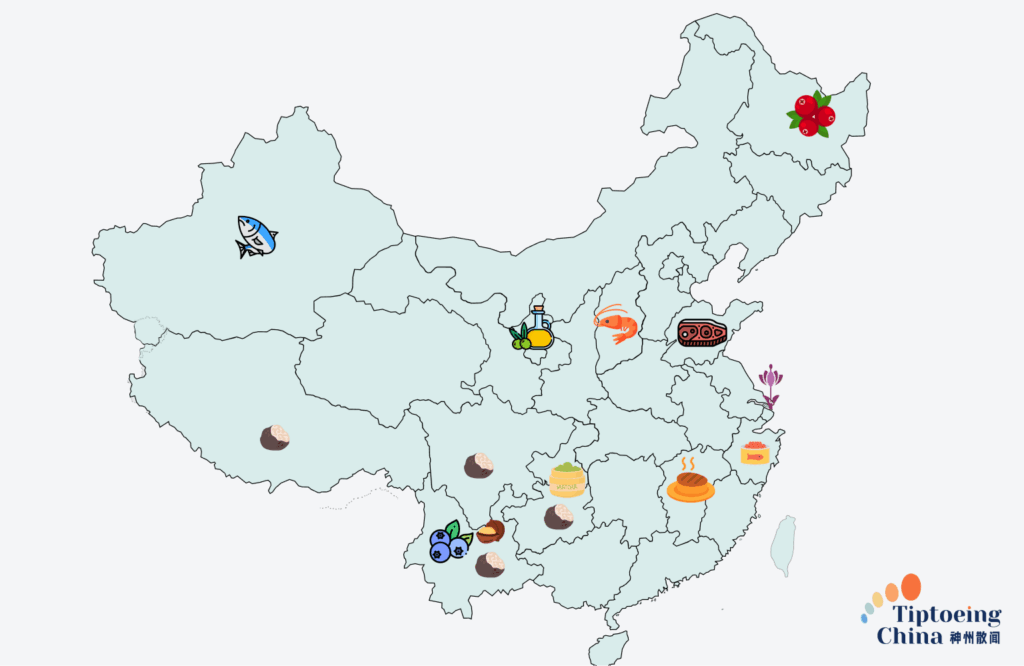
📍East China
- Zhejiang (Thousand Islands Lake): Home to the world’s largest caviar producers
- Shanghai (Chongming Island): Grows saffron for cosmetics, food, and wellness
- Anhui (not in the east costline, more like central east): Produces one-third of China’s foie gras
- Shandong: Breeding Wagyu-cross cattle for domestic luxury beef
📍Southwest China
- Guizhou: Now China’s top matcha producer, with exports to Japan and Europe
- Yunnan: Blueberries and macadamia nuts now harvested year-round
- Sichuan & Yunnan & Tibet: Experimental black truffle farms are taking root
📍North & Northeast & Northwest China
- Heilongjiang: Now a key cranberry production base
- Gansu: Produces 70% of China’s olive oil
- Shanxi: Repurposing salt flats for shrimp farming
- Xinjiang: Freshwater fish now exported to Japan, Russia, and ASEAN markets
🔍 Why It Matters
- These crops are not about scale—they’re about signal: quality, branding, global standards
- Farmers are upgrading from low-margin staples to high-return niches—increasing incomes and creating jobs, as these industries are often led by agricultural companies with structured employment models
- Luxury becomes local: Once unaffordable imports like caviar and foie gras are now produced domestically—making them more accessible to Chinese consumers
- Export-driven safety standards are pulling the entire food system forward
- Regional identity is being reshaped not just through geography, but through taste
🧭 What’s Driving It?
- 🌎 Export standards: To enter international markets, Chinese producers must reduce chemical use, adopt humane practices, and meet increasingly strict certifications
- 🧪 Tech and traceability: From AI drones that count fish to QR-coded sturgeon, digital systems now track every stage of the production chain
- 🛡️ Brand trust: Building trusted Chinese brands is critical—not just for domestic markets, but for global ones. Many Western consumers still hesitate to buy food labeled “Made in China,” even though much of what they eat is produced in China and rebranded abroad. Reclaiming that label with quality and transparency is now part of the strategy
- 📈 Policy push: Under the 14th Five-Year Plan (十四五规划), the government made rural modernization a national priority—explicitly calling for industrial upgrading and green growth (产业转型升级和绿色发展 ) as essential steps toward building a modern socialist country
🍽️ The New Flavor of “Made in China”
In each case, the product tells a bigger story:
- Of rural reinvention
- Of global ambition
- Of China not as factory—but as farm, lab, and kitchen
This is China’s soft power, grown in soil, refined by science, and carried quietly across borders.