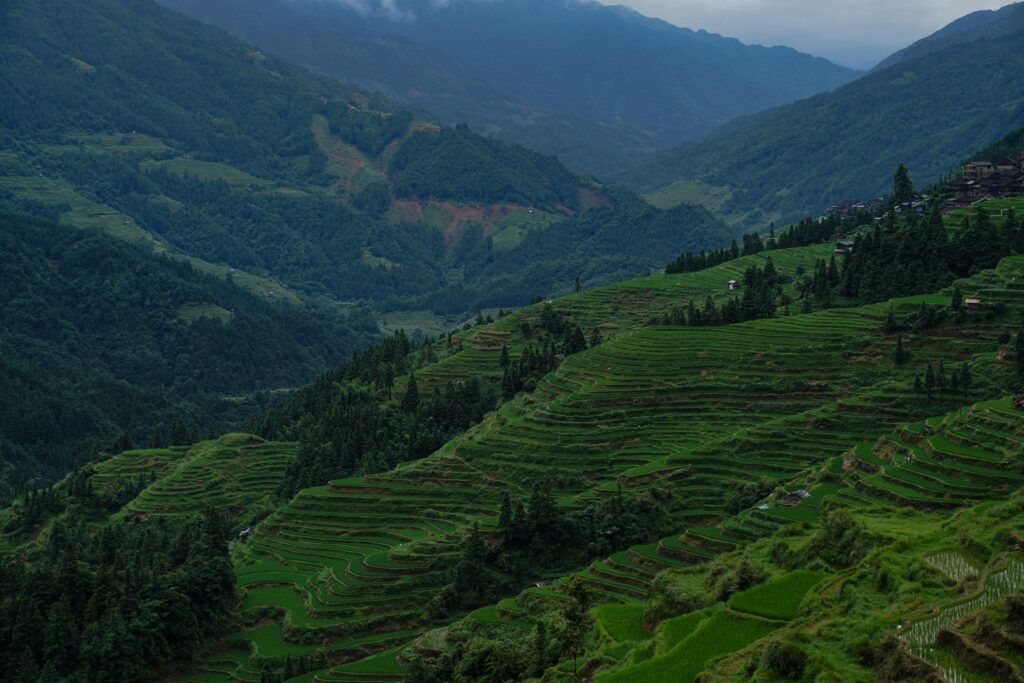
📍 Southwest China has long been one of China’s most remote and underdeveloped regions. Rugged terrain and limited infrastructure made large-scale industry difficult. But that’s changing.
As transportation improves and agriculture modernizes, these inland provinces are discovering new opportunities rooted in elevation, climate, and biodiversity. From matcha exports in Guizhou to year-round blueberries in Yunnan, the region is quietly rewriting its economic story—one crop at a time.
🍵 Guizhou: Clean Tea, Global Taste
In China’s traditional tea world, Guizhou was a latecomer. But that late start turned into an advantage.
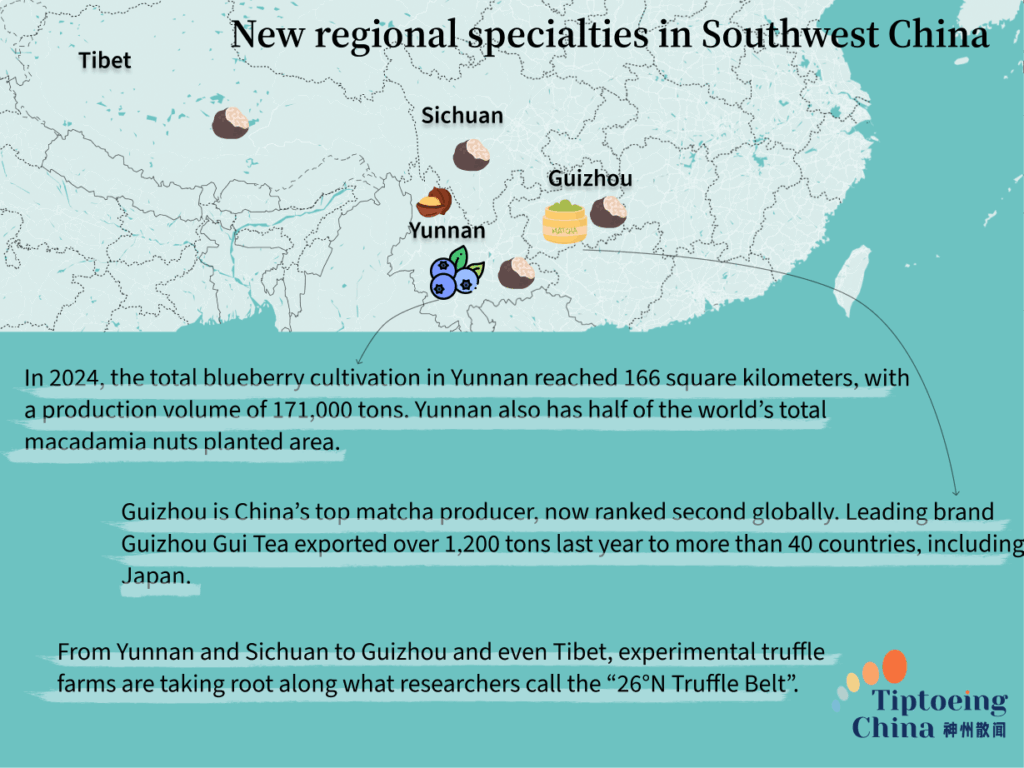
With newer tea gardens, modern processing, and a strong focus on what locals call “clean tea”—meaning no pesticide residue and no pollution (无农残、无污染)—Guizhou has become the country’s top matcha producer, now ranked second globally. Leading brand Guizhou Gui Tea (贵茶) exported over 1,200 tons last year to more than 40 countries, including Japan.
🌱 Why it works?
- Newer infrastructure makes it easier to meet export standards and modern consumer expectations
- The matcha wave is booming among China’s younger generation: on Xiaohongshu (Red), a youth-dominated social platform, posts about matcha jumped from 1 million to over 3 million in 2023
- Matcha is becoming mainstream:
- Hotpot chain Haidilao launched a viral matcha latte
- Hema (Alibaba’s grocery brand) released a matcha roll cake that sold 5x better than its peers
- New matcha-themed products are appearing across bubble tea chains, bakeries, and ready-to-drink aisles
Matcha here isn’t just a health trend—it’s a cultural moment. And for Guizhou, it’s a global ticket rooted in clean soil and smart timing.
🫐 Yunnan: Fruit That Bends the Calendar
With its highlands, valleys, and subtropical sun, Yunnan is often called China’s “three-dimensional climate zone.” That diversity is now turning the province into a powerhouse for specialty fruits—blueberries and macadamia nuts in particular.
🫐 Blueberries
In 2024, the total blueberry cultivation in Yunnan reached 166 square kilometers, with a production volume of 171,000 tons. The industry’s estimated output value is approximately 17 billion yuan ($2.3 billion USD).
- Before 2016, blueberries in China were mostly grown in the north, available only in summer—and priced as a luxury fruit for the middle class and above
- But Yunnan’s high-altitude, low-latitude climate allows for harvests from November to May, filling the winter market
- This shift made blueberries a popular Chinese New Year fruit, with fresher supply during off-seasons
- The short payoff cycle (just two years to recoup investment) attracted large-scale company farms—boosting supply, lowering prices, and turning blueberries into an affordable everyday fruit for most households
- Industrialized operations—from nursery to cold chain—are now standard in Yunnan’s berry fields
🥥 Macadamia Nuts
- As of 2023, Yunnan accounts for 81% of China’s macadamia orchards—spanning more than 2,500 square kilometers
- That’s nearly half of the world’s total planted area, making China the largest macadamia grower globally
- The trees thrive in Yunnan’s humid, temperate mountain slopes, where rainfall exceeds 1,000 mm and temperatures stay between 17–39°C
- With annual output now exceeding 9,500 tons, China ranks among the top three global suppliers
In both cases, altitude is Yunnan’s advantage—reshaping supply chains, calendars, and consumer access to what were once niche goods.
🍄 Black Truffles: A Delicate Experiment in the Mountains
Black truffles—long considered a culinary treasure in Europe—are now being quietly cultivated in China’s southwest highlands. From Yunnan and Sichuan to Guizhou and even Tibet, experimental truffle farms are taking root along what researchers call the “26°N Truffle Belt”, stretching from Chuxiong to Panzhihua and Nyingchi.
- In France, premium black truffles can fetch €5,000 EURO/kg, while in China, even high-end wild truffles sell for about 1,000 RMB /kg (€125 EURO/kg) —a fraction of the price
- Truffle farming is notoriously difficult—it still depends on trained pigs, dogs, and skilled foragers, which explains the high cost. But in recent years, small-scale cultivation has begun, with research farms in Yunnan, Sichuan, and Tibet achieving early success
China’s truffle scene is still young—but it reflects a broader trend: remote terrain becoming rare value.